Monday, February 29, 2016
The Beatles' "Revolution" Audience
By the time "Revolution" was released, the Beatles had already built themselves a solid fan base. They began releasing songs early in the 1960s, so by the time the 1968 anti-war song was released they had already attracted a lot of hippies and people with similar mindsets. "Revolution" opened a new range of listeners that broadened their audience. Along with their previous fans, anyone who felt negatively towards the war or had personal ties to the effects of the war started listening to the Beatles as well. The Beatles used this song to attract more people from different movements and to make a more political statement than they had before.

Logos; or the Complete Lack Thereof?

When writing "Revolution" John Lennon, wasn't focused on providing listeners with several facts and statistics on the war and why people should be against it, he wanted to voice his opinion on the issue of war and hoped that his listeners would agree. The Beatles had such a strong appeal to ethos with their audience, that focusing on logos was less important. Also, by focusing on several cold hard facts the song could actually have a lesser impact on the listeners. In an interview with Rolling Stone Lennon explained that while writing this song:
"I had been thinking about it up in the hills in India. I still had this 'God will save us' feeling about it, that it's going to be all right (even now I'm saying 'Hold on, John, it's going to be all right,' otherwise, I won't hold on) but that's why I did it, I wanted to talk, I wanted to say my piece about revolution. I wanted to tell you, or whoever listens, to communicate, to say 'What do you say? This is what I say.'"
John Lennon wrote this song with the assumption that listeners would be familiar with the current kairotic moment of a time in which people were fighting for peace not war. The Beatles audience wanted to know what stance they should be taking during antiwar movement. Lennon is able to effectively create such a tenacious argument through this song without an appeal to logos, because he focuses primarily on pathos, ethos, and the popularity of the group along side their large following.
-Gina Cole
Sunday, February 28, 2016
Logos and Lucy in the Sky with Diamonds
Rebecca Tomilchik
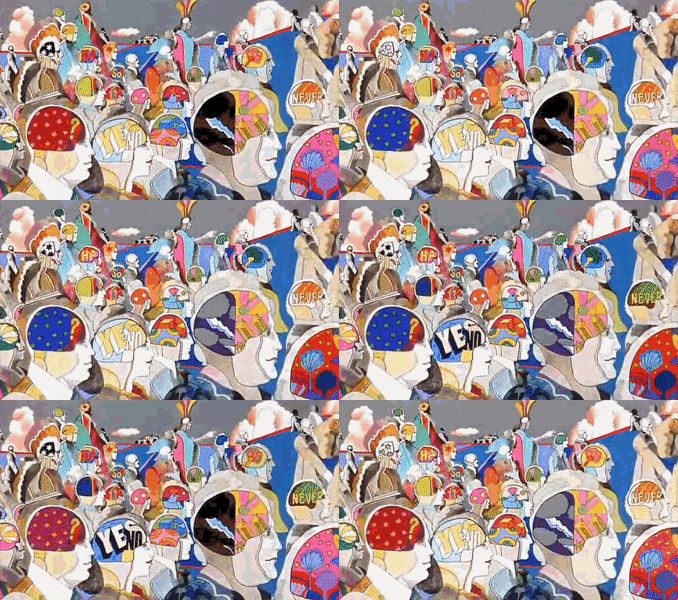
Logos is the rhetorical term used to demonstrate the logic of a piece of literature. Through reasoning, research, statistics, charts, etc., logos appeals to the logic of an audience. In the case of the Beatles song, “Lucy in the Sky with Diamonds,” it is challenging to pinpoint the logos, since it is basically about tripping on acid. In my opinion, the best way to attempt to describe the logos of this song is to explain how there isn’t any; the lack of logos makes the song more logical. “Lucy in the Sky with Diamonds” is a piece of creative fiction, a song meant to make people smile and reflect on life. For example, the lack of logos is exemplified by the stanza:
Newspaper taxis appear on the shore
Waiting to take you away
Climb in the back with your head in the clouds
And you're gone
Although there is no technical logic to this song, such as graphs or statistics, there is a certain element of organization that pertains to the era itself. The nonsensical lyrics serve to demonstrate the free-spiritedness that The Beatles were attempting to emulate through “Lucy in the Sky with Diamonds.” The 1960’s were considered to be a hectic time of revolution and protest, and the only logos that was apparent was the need to change society.
Saturday, February 27, 2016
Audience- Lucy in the Sky with Diamonds
Rachel Stern

Lucy in the Sky with Diamonds was released during a time when many people in society were falling under the influence of The Hippie Movement, and the fascination of experimenting with drugs. Even though The Beatles released many claims that this song had nothing to do with LSD or any drugs for that matter, the audience’s response was what led many to believe these speculations. An important part of 1967, noted as “The summer of love”, had a huge impact on the way this song was interpreted. During this summer, many young people were falling victim to popular culture and the glamour and lure of drug use. Many artists released music during this time and would preform at festivals where people gathered to bond and let loose. Many felt that they connected to this song and that the lyrics were representative of some of the effects of using LSD. Although The Beatles didn't deliberately write this song about drug use, the audience it was released to at the time played a huge role in the way the song was interpreted and would be remembered.
Thursday, February 25, 2016
Ethos in “Revolution”
Natania Lipp
Part of the Beatles’ fame comes from their ability to establish themselves as credible and likable. In “Revolution,” they establish ethos by building onto their already well known track record, and by maintaining a confident tone and vocabulary. However, they do not present themselves as more highly esteemed than their listeners. The song gives off the feel that everyone is in the same situation together. When they say “Well, you know we’re doing what we can” they make their personal intentions seem like a group effort. This language helps bring people together with a common sense of home for the future, and a renewed understanding of the importance of peace. The way that they use their words also maintains clear confidence in what they are saying. The Beatles' way of staying calm and confident throughout the song reinforces that words that they say.
Major Rhetorical Argument/Stasis for “Revolution”
Natania Lipp
In “Revolution” the Beatles challenge the importance of money, destruction and even government policies in their search for peace. They say, “you can count me out” to the idea of destruction, and instead claim that, “you have to wait”. They argue for passive strategy towards achieving peace by using evaluation/value. The Beatles question and discard the importance of money and destruction, and they put their value towards waiting for peace without taking physical action. They bring this concept to their listeners with a cool and confident tone so that their laid back words compliment their upbeat tune. Their use of stasis #3 is convincing because they bring people together in hope simply by changing the value that other people put on physical things.
In “Revolution” the Beatles challenge the importance of money, destruction and even government policies in their search for peace. They say, “you can count me out” to the idea of destruction, and instead claim that, “you have to wait”. They argue for passive strategy towards achieving peace by using evaluation/value. The Beatles question and discard the importance of money and destruction, and they put their value towards waiting for peace without taking physical action. They bring this concept to their listeners with a cool and confident tone so that their laid back words compliment their upbeat tune. Their use of stasis #3 is convincing because they bring people together in hope simply by changing the value that other people put on physical things.
Pathos- Lucy in the Sky with Diamonds
Rachel Stern

Lucy in the Sky with Diamonds has a strong appeal to pathos. The first major point is that this is a song; songs tend to have an appeal to pathos because people find themselves connected to a song, whether or not they realize the meaning. One of the definitions of pathos is that it is focuses on the emotions (or imagination) in the audience, and Lucy in the Sky with Diamonds directly plays into the imagination of the listeners. Throughout the song there are countless lyrics that raised speculation, while also allowing listeners to picture images and experiences in their minds. Lines such as, “a girl with kaleidoscope eyes” and, “Where rocking horse people eat marshmallow pies” are just a few examples that show how the word choice really impacted the way people interpreted it. Also, because this song was released during a time when The Hippie Movement and fascination with drug use was at its height, it had a huge impact on society as people felt they could personally connect to the lyrics.
Subscribe to:
Posts (Atom)